
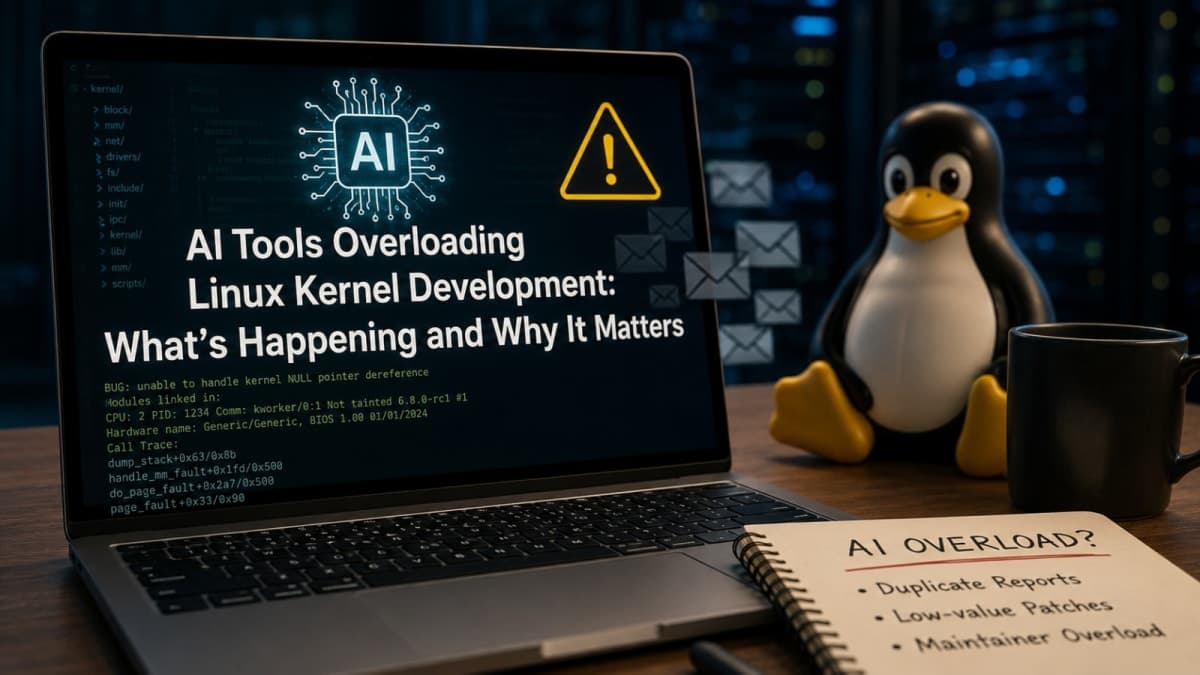
AI tools overloading Linux kernel development is a real problem right now. Duplicate bug reports and low-value patches generated by the same tools are flooding maintainers, especially the security mailing list. Linus Torvalds has called the situation almost unmanageable. The tools themselves are not banned, but the volume without enough human judgement creates extra work.
This matters for Indian developers, system administrators and students who rely on Linux for servers, cloud work, Android development and everyday machines. Kernel quality and update speed affect stability and security for everyone downstream. Understanding the current friction helps you use AI tools without adding to the noise.
What exactly is happening
Large language models and agent-style tools can scan kernel code and generate bug reports or suggested fixes in minutes. When many independent users point the same tools at the same tree, they rediscover the same issues. Those reports land on the private security list or public mailing lists.
Maintainers then spend time forwarding reports to the right subsystem, pointing out that a fix already landed weeks earlier, or discarding false positives. Torvalds described this as pointless churn. The list that should handle sensitive disclosures becomes clogged with duplication.
Similar pressure appears in other areas. Networking maintainers have reported higher patch volume and more late-cycle fixes. The staging tree, meant as a learning ground for new contributors, has seen enough LLM-generated clean-up patches that maintainers now reject most of them unless they are verified security fixes tested on real hardware.
On the positive side, AI tools have increased overall commit activity in recent release cycles. Some maintainers use them for review help, backport selection and mechanical clean-ups. The difference is between tools that reduce human work and tools that create new work that humans must still do.

Torvalds’ position and the current rules
Linus Torvalds has been clear. He will not ban AI tools. He has said Linux is not an anti-AI project and that critics who dislike this can fork or walk away. He treats AI as another tool, useful when it produces better results and harmful when it produces make-believe work.
His practical advice is consistent: if you find something with AI, do not stop at a report. Read the documentation, understand the code, write and test a proper patch, and add real value on top of what the tool produced. Drive-by reports that simply dump an AI finding create extra load for the few people who actually fix things.
Kernel documentation now treats coding assistants as tools that must follow normal process. Key points include:
Human responsibility. Only a human can add a Signed-off-by tag and accept the Developer Certificate of Origin. The submitter is accountable for the code, licensing and any bugs.
Attribution. Assisted-by tags identifying the tool and model have been discussed and used. Some maintainers question whether the tags mainly advertise commercial models; the exact policy continues to evolve.
Quality filters. Staging rejects most LLM-generated patches except genuine, hardware-tested security fixes. Other subsystems apply higher scrutiny to late-cycle or low-value changes.
The community is adjusting rules rather than pretending the tools do not exist.
Why the overload hurts more than it helps
Kernel development already runs on volunteer and company-sponsored maintainer time. Adding large numbers of near-identical reports turns scarce attention into a bottleneck. Real security issues can wait longer while people clear noise. Late-cycle patches that add bloat or irrelevant clean-ups force maintainers to be stricter, which can delay useful work.
False positives waste effort. Even when a tool is often right, a noticeable error rate still means many reports need human rejection. Older or rarely used drivers attract extra automated findings that have little practical impact for most users, yet still require triage.
For smaller open-source projects the same pattern can be worse. The Linux kernel has scale and many maintainers. A single-maintainer project can drown under the same volume of automated reports. Indian open-source contributors who maintain smaller tools or distributions feel this pressure too.
AI tools are great only when they actually help rather than create unnecessary pain and pointless make-believe work.
Practical impact for Indian users and developers
Most desktop and server users in India will not notice day-to-day changes. Distributions still ship kernels on their normal schedules. Android devices use related but separate trees. The risk is longer-term: slower absorption of important fixes or higher chance that low-quality changes slip through if review capacity is stretched.
Developers who contribute to the kernel or to drivers should treat AI output as a first draft. Always:
Test on real hardware or a proper test setup. Claims that an AI found a bug are not enough.
Write a clear changelog and explain the change. Maintainers need to understand why the patch is correct.
Check existing discussions. The same finding has often already been reported.
Prefer fixes over pure reports. A tested patch is more useful than another duplicate email.
Sysadmins and cloud teams in India who run custom kernels or out-of-tree modules should watch subsystem mailing lists for policy changes that affect how patches are accepted. Students learning kernel development should focus on understanding the code rather than generating volume with tools.

How the community is adapting
Maintainers are raising the bar on late-cycle and low-value submissions. Some subsystems limit the size of pull requests or apply quick filters to obvious AI-generated clean-ups. Documentation is being updated so that good actors know the expected process.
Tools that help maintainers triage (rather than only generate new reports) are more welcome. Experiments with AI-assisted review, backport selection and mechanical fixes continue when they reduce human load instead of increasing it.
Removal of old, unused code has also been used as a practical response. If automated tools keep finding issues in long-dead drivers, deleting the drivers removes the target and reduces noise.
None of this is final. AI capability is still changing quickly. The kernel process has always adapted to new tools. The current phase is about forcing quality and accountability rather than banning the technology.
What you should do if you work with Linux
If you only use Linux as a daily driver or server OS, keep applying normal updates from your distribution. No special action is required.
If you write or review kernel code, treat AI as a power tool that still needs a skilled operator. Generate candidates, then apply the same standards you would to any human patch: correctness, testing, clear explanation and respect for maintainer time.
If you run a smaller open-source project, consider simple filters or clearer contribution guidelines early. The same flood that hit the kernel security list can hit any public tracker.
For broader practical advice on tools and systems that matter to Indian users, see more guides on the site.
The Linux kernel remains one of the most carefully reviewed codebases in the world. AI tools change the volume and shape of contributions. The maintainers’ response so far is consistent with the project’s long history: accept useful help, reject noise, and keep human judgement in the critical path. That approach is the best protection for the stability that Indian servers, developers and devices depend on.