
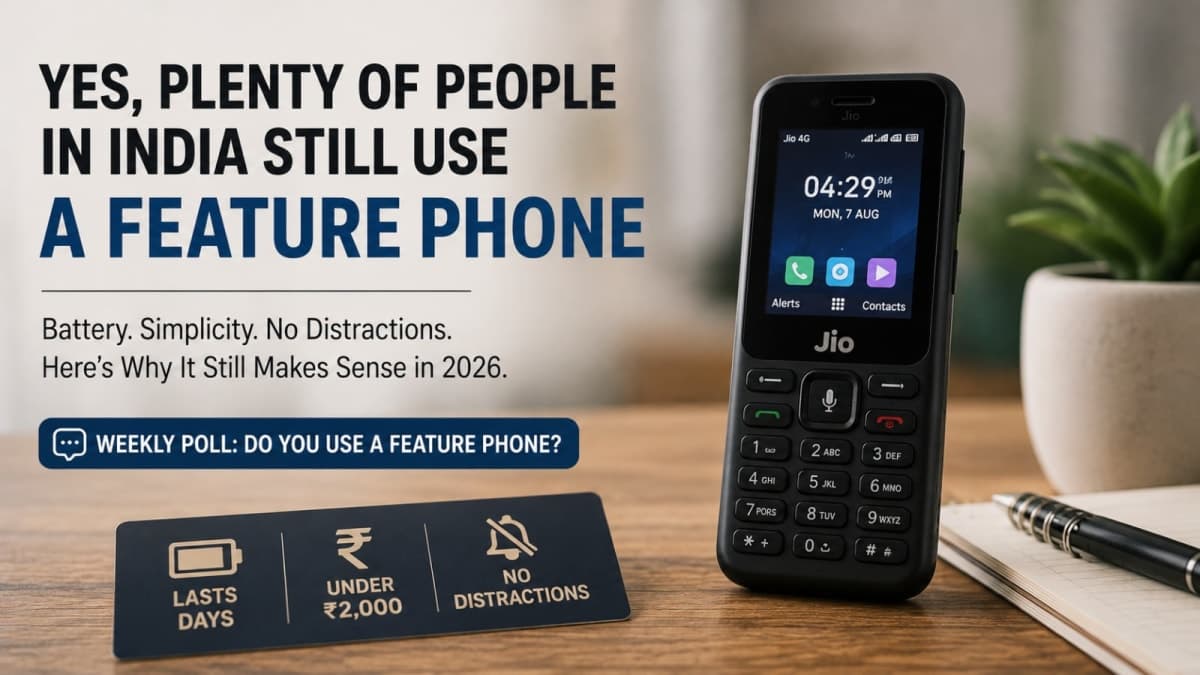
Yes, plenty of people in India still use a feature phone. Around 220 million feature phone users remain, and many of them choose the keypad deliberately for battery life that lasts days, prices under ₹2,000, almost zero distractions, and the ability to make calls and send messages without the noise of a smartphone. Some even use modern 4G models that handle UPI payments and basic apps. This weekly poll asks the simple question: do you use a feature phone, and why?
The answers are rarely the same. For some it is pure practicality. For others it is a conscious break from constant notifications. Below we look at the real reasons these phones still make sense in 2026, what the current models actually deliver, and where the trade-offs sit.
Why feature phones refuse to disappear
India’s feature phone base is still large even as overall shipments decline. Counterpoint and other trackers put the installed base near 220 million, with 35–40 million of those on 4G. The shift to smartphones continues, yet many users keep or buy keypad phones because the practical gaps remain wide.
Battery life. A typical feature phone with a 1,000–2,000 mAh cell often runs three to five days on light use. Many smartphones still need a charge every night. For someone who travels, works outdoors, or simply hates hunting for a plug, that difference is decisive.
Cost of ownership. A usable 4G feature phone sits between ₹1,000 and ₹2,500. Losing or breaking it hurts far less than losing a ₹10,000 smartphone. Replacement is easy and cash does not leave the house for long.
Simplicity for older users. Physical keys, large fonts on some models, and a menu that stays the same year after year suit parents and grandparents better than layered Android settings and app permissions.
Secondary or work phone. Shopkeepers, delivery riders and office staff often keep a feature phone as a second number. Dual-SIM models let them separate personal and business calls without carrying two expensive devices.
The market is not growing the way it once did. 2G volumes are falling as networks wind down and cheap 4G smartphones become easier to finance. Yet the remaining users are sticky. They replace one feature phone with another rather than jump to a full smartphone.
What modern 4G feature phones actually offer
Today’s feature phones are not the same as the ones from ten years ago. Several brands now ship 4G VoLTE models that run lightweight operating systems and support a short list of useful apps.
Jio’s own lineup, including models like the Prima series, brought Facebook, YouTube, JioCinema, JioSaavn and UPI payments to a keypad form factor. Other makers such as Lava, itel and HMD (Nokia) followed with their own 4G devices. Some even experiment with transparent backs and louder speakers that look deliberately different from the usual black candy-bar shape.
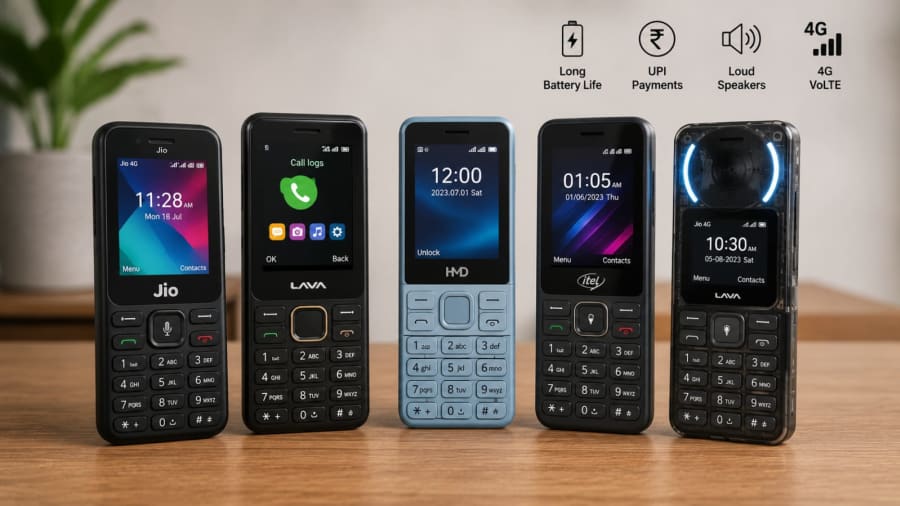
Key capabilities that matter in daily use:
UPI and payments. Many 4G models support JioPay or similar services so you can send money or scan a QR code without a smartphone.
Basic entertainment. Hotstar/JioCinema, music apps and a simple browser appear on several devices. Video quality is modest and data use is limited, but it is enough for short clips.
Call recording and dual SIM. Some Lava and itel models allow call recording without announcement and run two SIMs at once.
Long battery and loud speakers. Marketing claims of multi-day standby are usually realistic on light use. A few models also push speaker volume high enough for outdoor listening.
None of these phones replace a proper smartphone for banking apps, maps navigation while walking, or heavy social media. They are tools for calling, messaging, light payments and occasional video. That limitation is exactly the point for many buyers.
The digital detox angle
A growing group of urban users now treat a feature phone as a deliberate choice rather than a budget necessity. They keep a smartphone at home or in a bag and carry only the keypad device during the day. The goal is fewer interruptions.
One common pattern is the “dumb phone” experiment. People report cutting daily screen time from three hours or more down to essential calls and texts. No infinite scroll, no sudden work emails at 10 pm, no algorithm-fed videos. The phone is small, the screen is basic, and the absence of apps becomes a feature.
This is not pure nostalgia. It is a response to real fatigue. Notifications, blue light at night, and the constant urge to check something have pushed some people to set hard boundaries. A feature phone enforces the boundary because the apps simply are not there. Maps or podcasts can be added on certain models if needed, but the default is silence.
The most useful takeaway is simple: a feature phone does not have to be the only phone you own. Many people keep one as a secondary device for calls and battery life while the smartphone stays at home or in a drawer during focused work hours.
Battery, toughness and real-world trade-offs
Battery remains the strongest practical argument. A 1,000 mAh cell in a feature phone can outlast a 5,000 mAh smartphone battery under mixed use because the radio, screen and processor draw far less power. You charge it every few days instead of every night.

Durability is another quiet advantage. Most models have thicker plastic shells, physical keys that survive drops better than glass, and fewer fragile components. They are easier to repair at local shops and cheaper to insure against loss.
The trade-offs are equally clear:
Cameras are basic. Expect 0.3 MP or low-resolution sensors that are fine for a quick document photo but useless for social media or low light.
Internet is limited. Browsing and streaming work, yet page loads are slow and data plans are modest. The ₹123 Jio plan that gives 0.5 GB per day is popular precisely because heavy use is rare.
App selection is narrow. WhatsApp support has come and gone on some platforms. Full banking apps, food delivery and ride-hailing stay on the smartphone.
Future-proofing is weak. As 2G networks close and operators push 4G/5G, pure 2G phones will become less useful. Buyers should stick to VoLTE 4G models.
If your daily needs stay inside calling, SMS, UPI and light entertainment, the compromises are acceptable. If you rely on maps, multiple messaging apps or frequent photography, a budget smartphone under ₹10,000 is the better spend.
Who should still buy one in 2026
Four clear groups keep the segment alive:
Older family members who want a phone that does not change every year and whose battery does not die mid-call.
Budget-conscious or first-time users who need reliable voice and basic data without spending more than ₹2,000.
People seeking digital detox who deliberately limit access to social media and notifications during the day.
Secondary-phone users who want a tough, long-lasting device for work numbers, travel, or as a backup when the main phone is charging or forgotten.
Recent regulatory changes also help. Jio’s low-cost 4G plans that were once locked to its own devices are now available on compatible Lava, itel and HMD feature phones. That widens choice and removes one reason to stick only with a Jio-branded handset.
For current options and real prices, check recent listings rather than relying on old reviews. Models and offers move quickly. Our more guides section covers budget devices if you decide a smartphone still makes more sense.
Your turn: the weekly poll
So, do you use a feature phone? If yes, what is the main reason—battery, price, simplicity, detox, or something else? If you switched away, what finally made the difference?
Drop your answer in the comments. We read them and the patterns often shape the next set of practical guides. Whether you keep a keypad phone as your only device or as a deliberate second screen, the choice is more rational than many people assume. In a market still measured in hundreds of millions of users, the feature phone is not a relic. It is a tool that still solves specific problems better than anything else for a large group of Indians.