
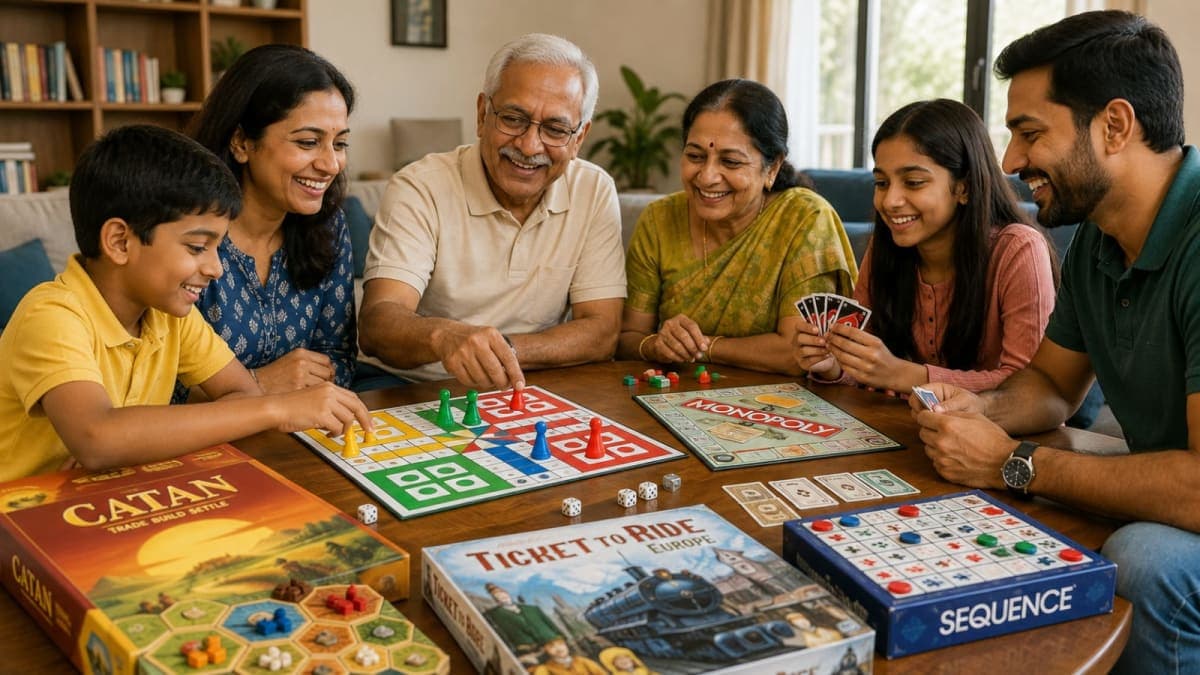
The best board games for families in India are the ones that multiple ages can play together without long rule explanations or constant arguments. Classics like Ludo and Sequence still work for most households. Modern options such as Ticket to Ride and Catan add strategy for older kids and adults. The right choice depends on your group size, available time, and how much strategy everyone wants.
Indian families often mix grandparents, parents and children of different ages. A good game needs simple enough rules for the youngest while still giving adults something to think about. Availability on Amazon, Flipkart and local stores also matters. Prices range from a few hundred rupees for basic Ludo sets to several thousand for imported strategy titles. Always check the latest listing before buying.
What makes a board game work for Indian families
Look at four practical points before you spend money.
Player count and ages. Most families need games that support 2 to 6 players. Check the recommended age on the box. Games marked 8+ or 10+ usually work better when mixed ages play together.
Play time. Under 30 minutes keeps younger children interested. 45 to 90 minutes suits older kids and adults who want a fuller session. Avoid anything that regularly runs over two hours for regular family nights.
Luck versus skill balance. Pure luck games (simple dice races) frustrate adults quickly. Pure strategy games frustrate younger kids. The sweet spot has enough chance that anyone can win, plus enough decisions that skill matters.
Component quality and language. Cards and boards should survive repeated use. English rules are fine for most urban families; Hindi or bilingual instructions help wider groups. Avoid ultra-cheap copies that miss pieces or have faded printing.
Traditional Indian games such as Carrom, Chess and local variants of Pachisi still deliver strong value. They need almost no setup and work across generations. Modern boxed games add variety and clearer scoring systems.

Reliable classics that still deliver
These games appear in most Indian homes for good reason. They are easy to find, cheap to replace, and require almost no teaching.
Ludo remains the default. Four players race tokens around a board using dice. Rules take two minutes to explain. It works for ages 5 and up. Many sets now come as 2-in-1 or 5-in-1 boards that also include Snakes and Ladders. The main limitation is heavy reliance on luck. Adults may get bored after a few rounds, but it still fills an evening when mixed ages gather.
Monopoly (or the Indian Business versions) teaches basic money decisions. Players buy properties, charge rent and try to bankrupt others. Play time often stretches past an hour. It suits ages 8+. The India editions use familiar city names and currency notes, which helps younger players. Trade-off: games can run long and the last player eliminated may sit out for a while.
Sequence mixes cards and a board. Players try to form lines of five chips. It supports more players than Ludo and has a clearer mix of luck and planning. Rules stay simple. Many Indian families treat it as the go-to gift for older children. Check that the set includes enough chips and a sturdy board.
Carrom and Chess sit in a different category. Carrom needs a proper board and striker practice. Chess builds pure strategy. Both reward repeated play and work well for two players or parent-child sessions. They require more skill development than the dice-and-token games.
Modern games worth the extra money
Once the classics feel too familiar, these titles add more decisions without becoming complicated.
Ticket to Ride asks players to claim train routes across a map by collecting coloured cards. Rules can be taught in under 15 minutes. Play time sits around 45-60 minutes. It works for ages 8+ and 2-5 players. The Europe version is commonly available in India. The main trade-off is price: expect to pay more than for Monopoly or Sequence.Components feel solid and the game scales well with different group sizes.
Catan (Settlers of Catan) focuses on resource trading and building settlements. Players collect wood, brick, wheat and other resources, then trade with each other. It needs 3-4 players for the best experience and takes 60-90 minutes. Ages 10+ handle it best. The social trading element creates conversation. The downside is longer setup and the need for everyone to stay engaged for the full game. Official editions and good reprints are sold through major online stores.
Simpler modern options include UNO for pure card chaos, Jenga or tumbling-tower sets for physical skill, and memory or matching games for younger children. These fill short gaps or travel bags without demanding table space.
Game type | Best for | Typical play time | Main trade-off |
|---|---|---|---|
Ludo / Snakes & Ladders | Mixed ages, quick fun | 20-40 min | Heavy luck |
Sequence / Monopoly | Family evenings | 30-90 min | Can run long |
Ticket to Ride | Older kids + adults | 45-60 min | Higher price |
Catan | Strategy lovers | 60-90 min | Needs 3-4 focused players |
How to match a game to your household
If most players are under 8, stay with Ludo, simple matching games or short cooperative titles. Attention spans are short. Avoid anything that punishes early mistakes heavily.
For mixed ages including grandparents, prioritise low reading requirements and clear turn structure. Sequence, Ludo and basic Monopoly fit. Teach one new rule at a time.
When the group is mostly teens and adults, Ticket to Ride or Catan become more rewarding. They still stay accessible but reward better decisions over pure chance.
Large gatherings (8+) need party-style games or multiple smaller boards running at once. UNO, simple card games or traditional group games work better than one complex board that only seats four.
Space and storage matter in many Indian homes. Compact card games or foldable boards travel and store more easily than large maps with many tokens.

Buying tips that avoid disappointment
Buy from reputable sellers. Official Funskool, Hasbro or Asmodee editions usually have better printing and complete components than unbranded copies. Read recent reviews for missing pieces or warped boards.
Check the exact player count and age range on the product page, not just the marketing title. Some “family” games are really for ages 12+.
Consider expansions only after the base game proves popular. Many families never open the first expansion.
For traditional games, a good wooden Carrom board or magnetic Chess set lasts years. Cheap plastic versions wear out faster.
If budget is tight, start with one classic (Ludo or Sequence) and one short modern card game. Add a strategy title later once you know the family enjoys longer sessions.
Prices move with sales. Independence Day, Diwali and year-end offers often drop the cost of popular titles. Compare Amazon, Flipkart and brand sites on the day you buy.
For more practical buying advice on everyday products that hold up in real Indian homes, see more guides on the site.
Final checklist
Confirm the game supports the number of people who will actually play. Read the age recommendation honestly. Prefer games with mixed luck and skill so different ages stay interested. Check component quality in reviews. Buy authentic editions when possible.
A good family board game earns its space by getting pulled out repeatedly. The ones that work longest in Indian homes are usually the simplest to teach and the fairest across ages. Start there, then add complexity only if everyone asks for it.