
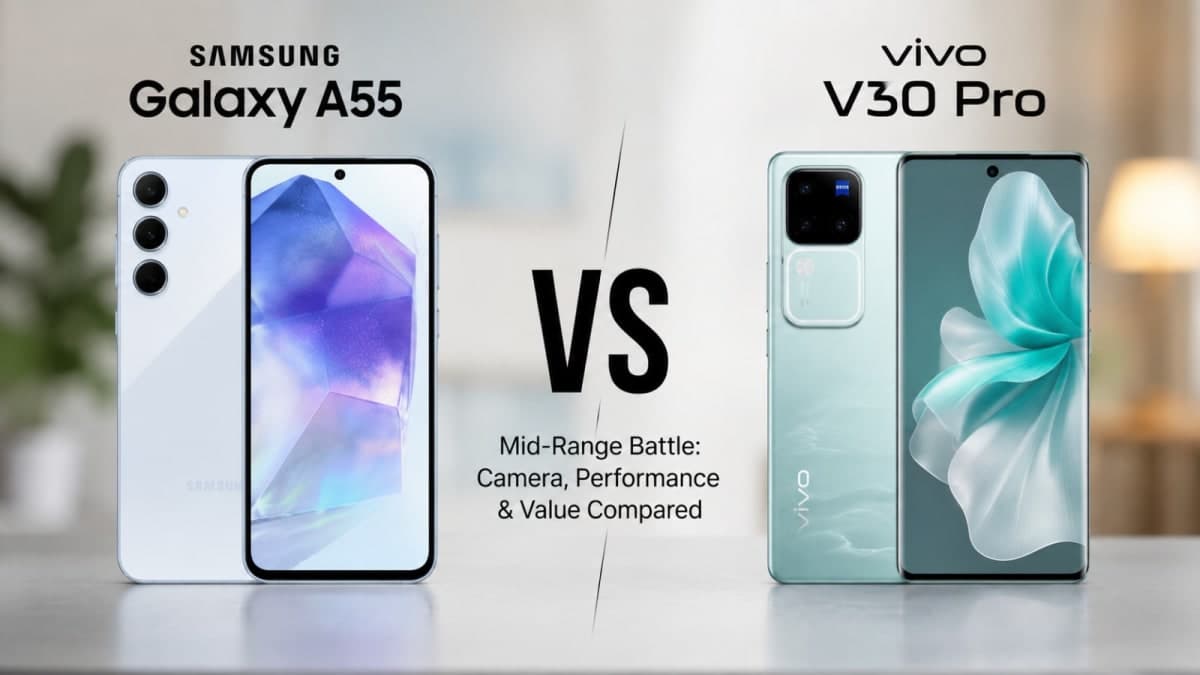
The Galaxy A55 vs Vivo V30 Pro decision comes down to priorities: the Vivo V30 Pro is the stronger everyday camera and charging phone, while the Samsung Galaxy A55 is the safer long-term pick with better protection and software support. Both launched in early 2024 as affordable premium options and still make sense if you find them at the right price in India today.
These two phones sit in the same mid-range bracket and aim at buyers who want better screens, cameras and build than basic models without jumping to flagship money. Here is how they actually compare on the points that matter when you spend real money.
Design, display and build quality
The Vivo V30 Pro feels lighter and more premium in the hand. It weighs around 188g and is only 7.45mm thick, with a curved 6.78-inch AMOLED panel that gives a higher screen-to-body ratio. Peak brightness reaches up to 2800 nits, which helps outdoors in Indian sunlight. The Galaxy A55 is heavier at 213g and thicker at 8.2mm, but its flat 6.6-inch Super AMOLED is easier to use one-handed and less likely to suffer edge cracks.
Both run 120Hz refresh rates and support HDR10+. Colour and sharpness are close in normal use. The A55’s Gorilla Glass Victus+ and IP67 rating give it a clear durability edge for dust, rain and accidental drops in water. The V30 Pro is only IP54 rated, so it handles light splashes but nothing more serious. Fingerprints show easily on both glossy backs.

Display size and brightness. Vivo’s larger, brighter curved panel wins for media and outdoor visibility.
Durability. Samsung’s IP67 and tougher glass make the A55 the more practical daily driver if you are rough with phones.
Comfort. The A55’s flatter sides and rounded frame often feel more secure for longer calls or one-handed scrolling.
Performance, software and storage
The Vivo V30 Pro uses the MediaTek Dimensity 8200. The Galaxy A55 runs the Exynos 1480. In everyday apps, multitasking and light gaming both feel smooth. Benchmarks usually favour the Dimensity for raw scores, but the gap is small in real use. Neither phone is a heavy gaming machine; sustained high-frame-rate sessions will heat both up.
Software is where the A55 pulls ahead for Indian buyers who keep phones longer. Samsung promises four major OS upgrades and five years of security updates from launch. Vivo commits to only two major OS updates and three years of security patches on the V30 Pro. That difference becomes noticeable after the second year when one phone is still getting new Android versions and the other is not.
Storage also favours the A55 for flexibility. It offers microSD expansion up to 1TB via the hybrid SIM slot. The V30 Pro starts with higher base storage (256GB) and goes to 512GB but has no card slot. RAM options reach 12GB on both. One UI is cleaner and more consistent with Google services; Funtouch OS has more pre-installed apps that many users disable.
Camera comparison
This is the biggest practical difference. The Vivo V30 Pro carries a 50MP main sensor with OIS and Zeiss optics, a 50MP ultrawide and a 50MP 2x telephoto. The front camera is also 50MP. The Galaxy A55 has a 50MP main with OIS, a 12MP ultrawide and a 5MP macro, plus a 32MP front camera.
In good daylight both produce usable, social-media-ready shots. The A55 often keeps better edge detail and more natural dynamic range. The V30 Pro tends to push warmer, more saturated colours that many people prefer for Instagram. Portrait mode is a clear Vivo win: the dedicated 2x telephoto lets you frame tighter shots with more natural background blur and better subject separation.
Low light and ultrawide performance also lean toward the Vivo for detail and brightness, though the A55 holds up better on texture in some scenes. Selfies favour the V30 Pro’s higher-resolution sensor and Aura light features. Video is competent on both at 4K 30fps, with the A55 sometimes looking a touch more stable.
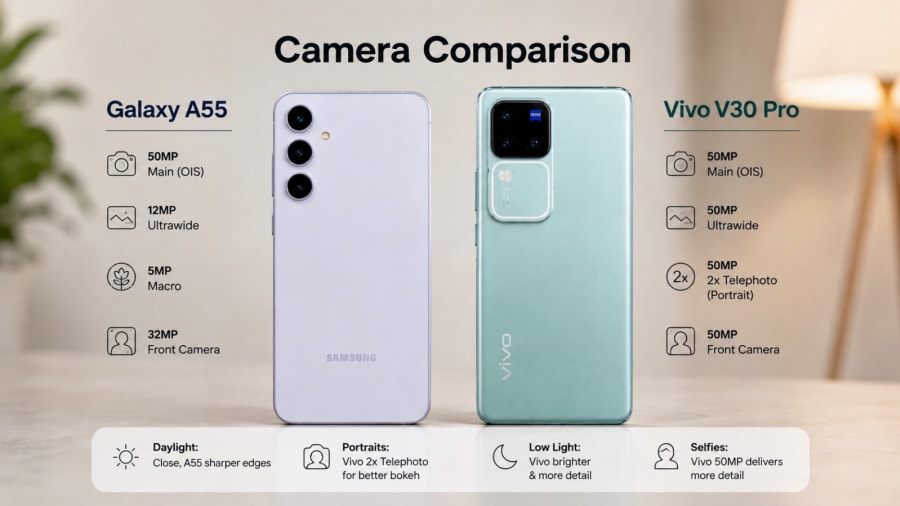
Portraits and zoom. Vivo’s 2x telephoto is the single biggest camera advantage.
Daylight main camera. Close, with Samsung often sharper at the edges.
Selfies and ultrawide. Vivo’s higher-resolution sensors deliver more detail.
Battery life and charging
Both phones use a 5000mAh battery. Real-world endurance is similar: a full day of mixed use with some camera, browsing and video is realistic for either. The difference is charging speed. The Vivo V30 Pro supports 80W fast charging and can reach high percentages in under half an hour with the included charger. The Galaxy A55 is limited to 25W, so a full top-up takes noticeably longer.
If you charge overnight or only need a quick top-up during the day, the slower A55 is fine. If you often leave home with a half-empty battery and need power fast, the Vivo is simply more convenient.
Pick the Vivo V30 Pro if camera flexibility and rapid charging matter most; pick the Galaxy A55 if you want longer software support, better water resistance and the option to expand storage later.
Price and who should buy which
Launch prices put the Galaxy A55 around ₹39,999 for the base variant and the Vivo V30 Pro around ₹41,999. Street prices in India have moved since then, so always check current offers on Flipkart, Amazon and brand sites before deciding. Both now sit in a competitive mid-range band where deals can swing the value equation.
Buy the Vivo V30 Pro if you take a lot of portraits, selfies or social photos, want the brighter larger screen, and hate slow charging. It is the more exciting daily phone for content creators and media users.
Buy the Galaxy A55 if you keep phones for three or more years, travel or work in dusty or rainy conditions, need expandable storage, or simply prefer Samsung’s cleaner software and longer update promise. The A55 is the more sensible long-term device.
Neither is a bad buy at the right price. For most Indian buyers who prioritise cameras and convenience, the Vivo V30 Pro edges ahead. For those who value durability and longevity, the Galaxy A55 remains the safer choice. Check the latest deals, hold both in a store if possible, and decide based on which trade-offs you can live with. For more mid-range options, see more guides on the site.