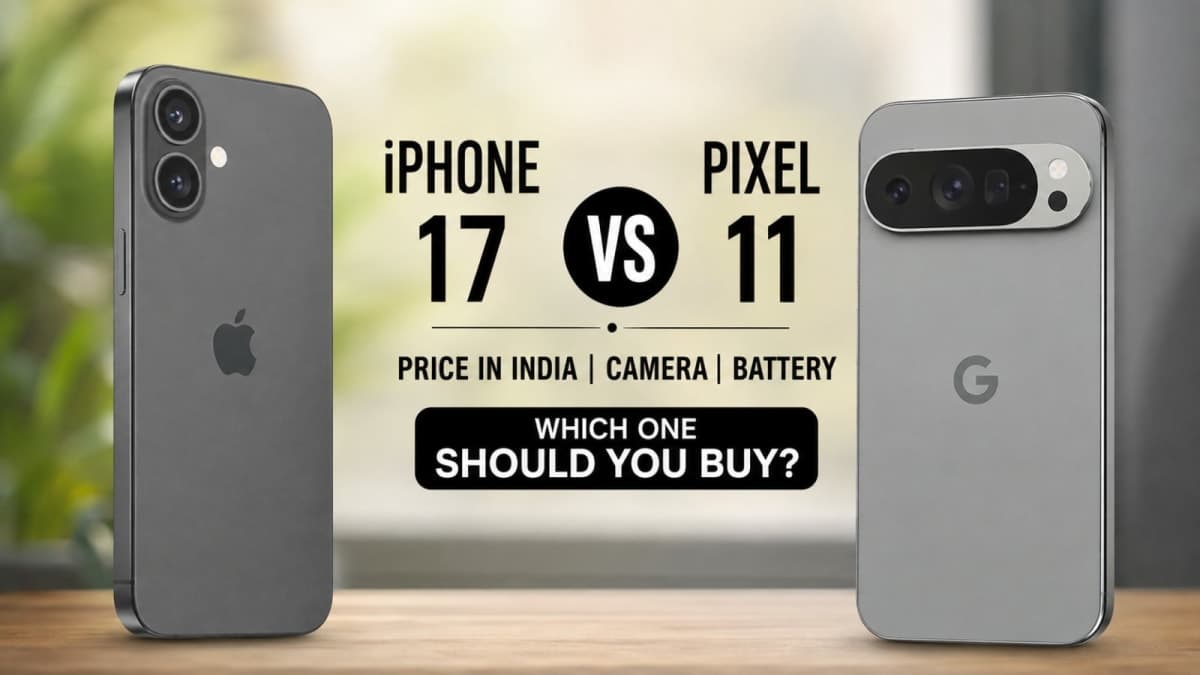
The Google Pixel 11 vs iPhone 17 price in India comparison starts with a clear gap: the iPhone 17 opens at ₹82,900 for 256GB while the Pixel 11 begins at ₹89,999 for 12GB + 256GB. Both phones are 6.3-inch flagships with 120Hz displays, strong cameras and long software support. The real decision is whether you want Apple’s polished ecosystem and faster charging or Google’s cleaner Android experience, better optical zoom and larger battery.
This post compares only the standard models not the Pro versions because that is where most buyers actually land. Prices are official India launch figures as of mid-August 2026. Street prices and bank offers can lower both, but the gap usually remains similar.

Price and Availability in India
The iPhone 17 launched in September 2025. Current official pricing is ₹82,900 for 256GB and ₹1,02,900 for 512GB. It is widely available through Apple Stores, Flipkart, Amazon and major retail chains. Bank discounts and exchange offers frequently bring the effective price lower.
The Pixel 11 launched on 12 August 2026. Official India pricing is ₹89,999 for 12GB + 256GB and ₹1,04,999 for 12GB + 512GB. Pre-orders opened immediately and retail sales begin 20 August. Google is offering cashback on HDFC EMI, no-cost EMI up to 24 months and an exchange bonus of up to ₹9,000.
On pure launch price the iPhone is cheaper. Storage starts at 256GB on both, so the old “iPhone base storage is tiny” argument no longer applies. The Pixel gives you more RAM out of the box (12GB versus 8GB), which helps with heavy multitasking and on-device AI features.
Model | 256GB Price | 512GB Price | RAM |
|---|---|---|---|
iPhone 17 | ₹82,900 | ₹1,02,900 | 8GB |
Pixel 11 | ₹89,999 | ₹1,04,999 | 12GB |
Display and Design
Both phones use 6.3-inch OLED panels that hit 3,000 nits peak brightness. The iPhone 17 has a sharper 1206 × 2622 resolution (around 460 ppi) with full ProMotion (1-120Hz) and Always-On display. The Pixel 11 runs a 1080 × 2424 panel (422 ppi) with a 60-120Hz adaptive refresh rate. In bright sunlight both remain readable. The iPhone’s higher pixel density and lower minimum refresh rate give it a slight edge for smooth scrolling and battery efficiency when the phone is idle.
Size and weight. The iPhone measures 149.6 × 71.5 × 7.95 mm and weighs 177g. The Pixel is 152.8 × 72 × 8.6 mm and 197g. The iPhone feels noticeably lighter and more compact in one hand.
Protection. iPhone uses Ceramic Shield 2 on the front. Pixel uses Gorilla Glass Victus 2. Both carry IP68 ratings.
Build. Both have aluminium frames. The Pixel’s camera bar is thinner than previous generations. The iPhone continues with the familiar flat sides and Dynamic Island.
If you prioritise pocketability and a sharper screen, the iPhone wins this round. If you prefer a taller aspect ratio and do not mind a few extra grams, the Pixel is fine.
Cameras: Zoom vs Consistency
This is the biggest practical difference.
The Pixel 11 carries a triple rear setup: 48MP main (larger 1/1.56-inch sensor, f/1.7, OIS), 13MP ultrawide and a 10.8MP 5x telephoto. Google claims 56% better light sensitivity on the main sensor and Super Res Zoom up to 30x. The front camera is 10.5MP.
The iPhone 17 uses a dual 48MP system: 48MP Fusion main with sensor-shift OIS and a 48MP ultrawide that also handles macro. It offers a 2x optical-quality crop from the main sensor but no dedicated telephoto. The front camera is an 18MP Center Stage unit.

Daylight photos. Both produce excellent results. Pixel processing often looks more natural; iPhone processing is slightly warmer and more consistent across apps.
Zoom. The Pixel’s 5x optical lens is a clear advantage for portraits and distant subjects. The iPhone relies on cropping and digital zoom beyond 2x.
Video. The iPhone remains stronger for stabilised 4K footage, Cinematic mode and consistent colour. Pixel video has improved but still trails in complex motion scenes.
Low light. Pixel Night Sight continues to extract more detail in near-dark conditions. The iPhone is very usable but less aggressive.
If you shoot a lot of zoomed portraits or wildlife-style shots, the Pixel’s telephoto matters. If most of your photos are family moments and social video, the iPhone’s consistency is harder to beat.
Performance, Battery and Charging
The Pixel 11 runs Google’s Tensor G6 (2nm process in some reports) with 12GB RAM. The iPhone 17 uses the A19 chip with 8GB RAM. Apple’s silicon still leads in sustained performance and efficiency in most independent tests. Day-to-day tasks feel identical on both. Heavy gaming and long video exports favour the iPhone.
Battery numbers look one-sided on paper. The Pixel 11 has a 4,985mAh cell and Google claims 30+ hours of mixed use. Wired charging reaches about 55% in 30 minutes at 30W; wireless is Qi2.2 at up to 25W. The iPhone 17 uses a roughly 3,692mAh battery. Apple claims up to 30 hours of video playback and 50% charge in 20 minutes with a 40W or higher adapter. Wireless charging reaches higher peak speeds on the iPhone in some tests.
In real Indian usage mixed 5G, social media, navigation and evening streaming both phones easily last a full day for most people. The Pixel’s larger cell gives more headroom if you are a heavy user or travel without a charger. The iPhone recovers faster when you do plug in.
The iPhone is cheaper to buy and charges faster. The Pixel gives you more battery capacity and a proper 5x zoom. Everything else is preference.
Software and Long-Term Ownership
Pixel 11 ships with Android 17 and a firm 7-year promise of OS and security updates plus Pixel Drops. That matches or exceeds most Android rivals. iOS 26 on the iPhone 17 will also receive many years of updates; Apple’s track record is excellent even if the exact number is not published in the same way.
Google’s AI features (Gemini, Magic Editor, Call Notes, live translation) are deeper on the Pixel and often run on-device. Apple Intelligence is improving but remains more limited outside the US in some languages. In India both phones handle Hindi and major regional languages reasonably well, with Google still ahead in voice input accuracy for many users.
Resale value and accessory ecosystem still favour the iPhone. Service centres for Apple are more widespread in tier-1 and tier-2 cities. Google’s service network has improved but remains thinner. If you plan to keep the phone for four or five years and then sell it, the iPhone usually returns more of its purchase price.
For more context on how long flagships actually stay useful, see our longer ownership guides.
Which One Should You Buy?
Buy the iPhone 17 if you want the lower starting price, smoother sustained performance, faster charging, stronger video and the highest resale value. It is the safer, more predictable choice for most people who are already in the Apple world or simply want the least friction.
Buy the Pixel 11 if you prefer stock Android, value the 5x telephoto, want Google’s latest on-device AI tools and do not mind paying a few thousand more for 12GB of RAM and a larger battery. It is also the better pick if you already use Google Photos, Gemini and Workspace heavily.
Neither phone is a bad buy at current pricing. The iPhone simply arrives at a lower entry point while delivering a more polished overall package for the average Indian buyer. The Pixel fights back with hardware that still feels distinctive, especially that telephoto lens and software that many people find freer and more useful day to day.
Check current bank offers and exchange values before deciding. Both phones will see discounts over the next few months, but the relative gap is unlikely to reverse dramatically. Choose the ecosystem you already live in and the camera style that matches how you actually take photos.