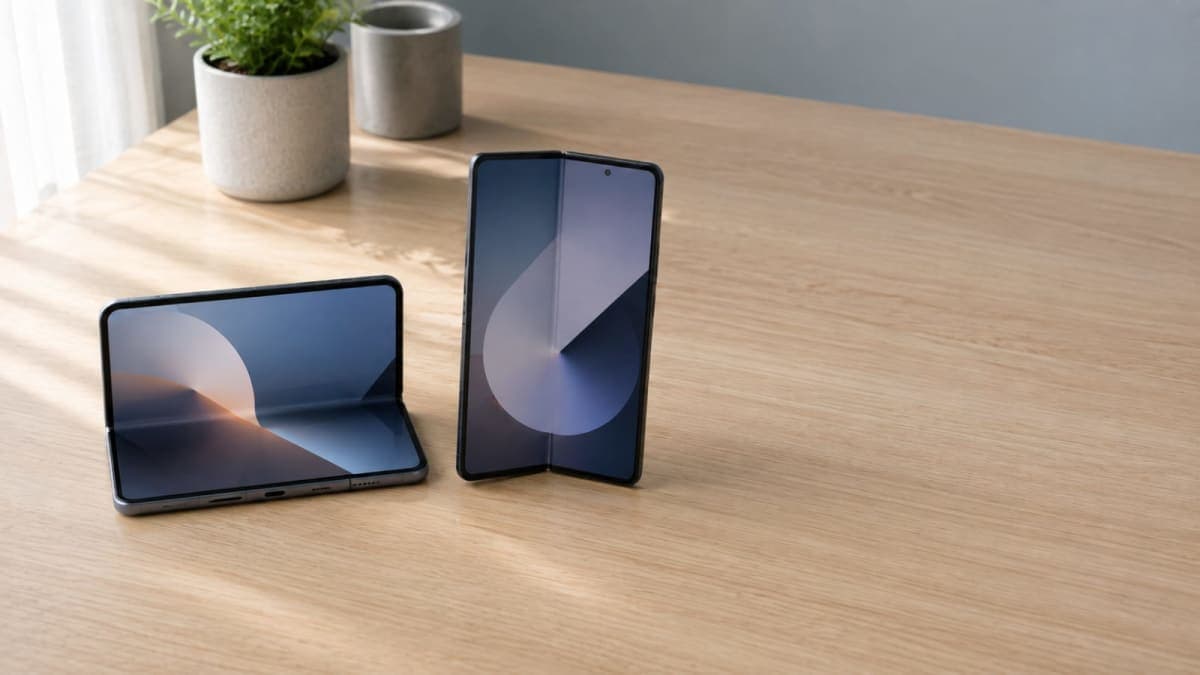
The Galaxy Z Fold 8 vs Fold 8 Ultra choice is straightforward once you know what you actually do with a phone. The regular Fold 8 is the lighter, wider device built for media and daily carry. The Ultra is the taller, more capable flagship aimed at productivity and photography. Both use the same Snapdragon 8 Elite Gen 5 for Galaxy chipset, run One UI 9 on Android 17, and start at high prices in India. The ₹20,000 difference and the completely different shapes decide the winner for most people.
Samsung launched both on the same day in July 2026. Pre-orders opened immediately and sales began in early August. Availability is solid through Samsung.com, major retailers and carrier stores across India. No charger comes in the box for either model, which is now standard.
Design and form factor: the real split
This is the biggest difference and the one that matters most in daily life. The Z Fold 8 uses a new wider, shorter “passport” shape. Folded it measures 123.9 × 81.9 × 9.7 mm and weighs 201 g. Unfolded it becomes 123.9 × 161.4 × 4.5 mm. The cover screen is 5.5 inches with a more conventional 10:16 aspect ratio that feels natural for one-handed use, messaging and short videos. The inner 7.6-inch display sits at a 4:3 ratio, which suits reading, gaming and video better than the older near-square Fold screens.
The Fold 8 Ultra keeps the classic tall book-style design. Folded dimensions are 158.4 × 72.8 × 8.9 mm and weight is 215 g. Unfolded it measures 158.4 × 143.2 × 4.1 mm. The cover is a full 6.5-inch panel and the inner screen jumps to 8.0 inches. It is thinner when open and still feels premium, but the extra 14 g and taller profile make it less pocket-friendly for some users.
Both use Flex Titanium technology under the display. The crease is noticeably less visible than earlier generations, especially once the screen is on. Both carry an IP48 rating and Advanced Armor aluminum frames. The Fold 8 simply feels more like a regular phone when closed because of the wider cover. The Ultra feels more like a traditional foldable tablet when open.

Displays and software experience
Both phones deliver bright Dynamic AMOLED 2X panels with adaptive 1-120 Hz refresh rates and peak brightness up to 3,000 nits. Anti-reflective coating on the inner screens helps outdoors. The practical difference is size and shape.
Cover screen. The Fold 8’s 5.5-inch panel is easier to use one-handed for typing and scrolling. The Ultra’s 6.5-inch cover is larger and closer to a normal flagship phone, which some people prefer for maps and notifications.
Inner screen. The Ultra’s 8-inch canvas gives more room for three apps side by side or large documents. The Fold 8’s 7.6-inch 4:3 panel is better for movies and games without extreme letterboxing.
Flex Mode. Available on the Ultra, missing on the regular Fold 8. Samsung removed the software support even though the hinge can still hold intermediate angles. If you use the half-folded laptop-style pose for video calls or recipes, the Ultra is the only option.
Both run the same One UI 9 software with seven years of OS and security updates. Multitasking tools, DeX and the usual Galaxy AI features are identical. The form factor changes how useful those tools feel.
Camera: Ultra pulls ahead clearly
Here the gap is large. The Fold 8 Ultra carries a triple rear setup: 200 MP main with OIS and improved HDR, 50 MP ultrawide, and a 10 MP telephoto with 3x optical zoom. It also supports 8K video with the APV codec and Cine LUT colour tools aimed at creators.
The regular Fold 8 has only dual 50 MP cameras (main + ultrawide). It relies on in-sensor crop for 2x zoom and lacks a dedicated telephoto. Both phones have 10 MP cover and under-display front cameras that are competent but not class-leading.
If photography or occasional optical zoom matters, the Ultra is worth the extra money. If you mostly shoot social content and video calls, the Fold 8’s dual 50 MP setup is still very good and avoids the bulk of a third lens module.

Battery, charging and performance
Both use silicon-carbon battery chemistry for the first time in Samsung’s Fold line. The Fold 8 has a 4,800 mAh typical capacity. The Ultra steps up to 5,000 mAh. Both support 45 W wired charging (roughly 63-67 % in 30 minutes with a compatible adapter) and 20 W wireless charging plus reverse wireless.
Real-world difference is modest but measurable. The Ultra’s larger cell and slightly more efficient thermal design help during long multitasking or gaming sessions on the bigger screen. Neither phone will last two full heavy days for most users, but both clear a solid day of mixed use.
Performance is identical on paper. The Snapdragon 8 Elite Gen 5 for Galaxy, up to 16 GB RAM and up to 1 TB storage deliver flagship speed. Sustained performance benefits from the Ultra’s expanded cooling in prolonged workloads, but day-to-day apps, games and AI features feel the same.
Feature | Galaxy Z Fold 8 | Galaxy Z Fold 8 Ultra |
|---|---|---|
Starting price (India) | ₹1,79,999 | ₹1,99,999 |
Weight | 201 g | 215 g |
Main display | 7.6-inch 4:3 | 8.0-inch |
Cover display | 5.5-inch | 6.5-inch |
Rear cameras | 50 MP + 50 MP UW | 200 MP + 50 MP UW + 10 MP 3x |
Battery | 4,800 mAh | 5,000 mAh |
Flex Mode | No | Yes |
Buy the Fold 8 if you want the lightest, most phone-like foldable for media and daily carry. Buy the Ultra only if you need the bigger tablet screen, optical zoom and Flex Mode enough to justify the extra ₹20,000 and 14 g.
Who should buy which in India
Choose the Galaxy Z Fold 8 if:
You value weight and pocketability. At 201 g it is the easiest full-size foldable to live with every day.
Media and reading matter more than multitasking. The wider 4:3 inner screen and natural cover display suit Netflix, YouTube and books better.
You want to save ₹20,000. That money buys a good pair of earbuds, a watch, or simply stays in your account.
Choose the Galaxy Z Fold 8 Ultra if:
You split apps constantly or work on documents. The 8-inch screen and taller proportions give real tablet utility.
Camera is a priority. The 200 MP main and 3x telephoto are meaningfully better.
You use Flex Mode. It remains useful for video calls, cooking and presentations.
Both phones are expensive. At these prices you should also look at last year’s Fold 7 if deals appear, or consider whether a regular Ultra-style flagship plus a tablet would serve you better for less money. For pure foldable experience in 2026, the new pair is the cleanest choice Samsung has offered.
Trade-in values and bank offers on Samsung.com can shrink the gap, so check current deals before deciding. Either way, you get seven years of software support and a device that still feels special a year later provided you pick the shape that matches how you actually use a phone.
For more foldable context see more guides on the site, or check current premium phone options if the ₹1.8 lakh starting price still feels steep. There are many more option in market, if you want some suggestion contact us on contact.shreemobile@gmail.com .