
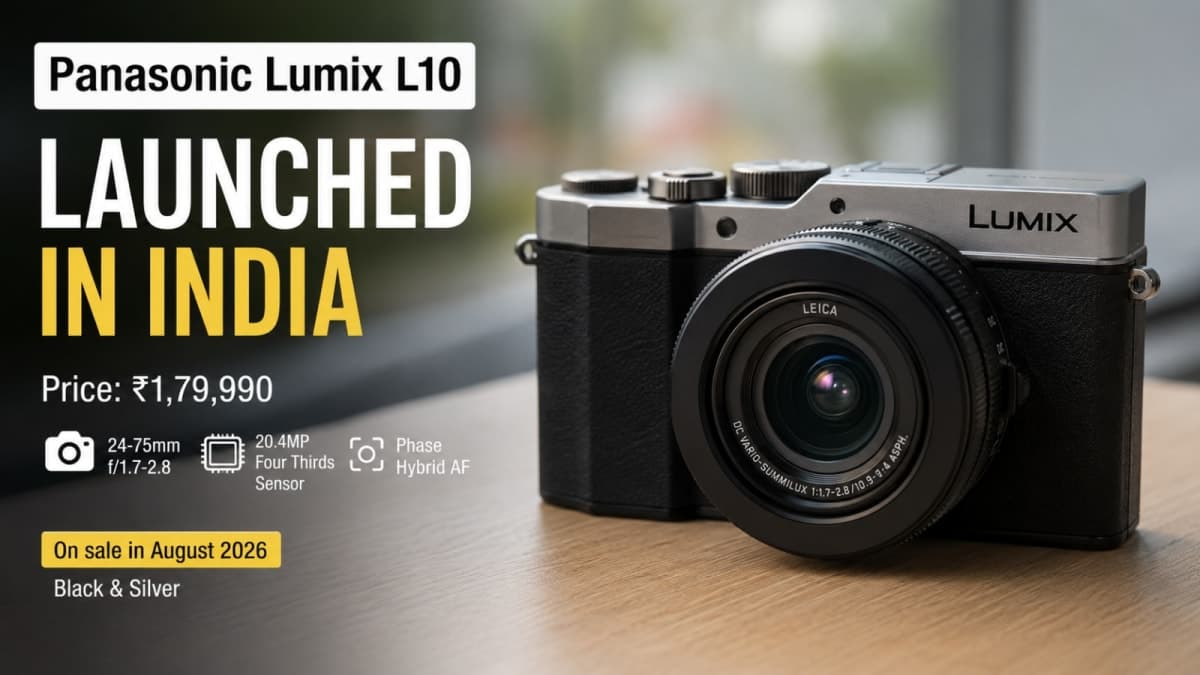
Panasonic Lumix L10 has launched in India at an MRP of ₹1,79,990. This fixed-lens compact pairs a Leica 24-75mm f/1.7-2.8 zoom with a 20.4MP Four Thirds BSI CMOS sensor, Phase Hybrid AF and solid video features, marking the brand’s 25th anniversary. It goes on sale later in August 2026 in Black and Silver.
If you want a pocketable camera that does more than a fixed 35mm or 28mm prime, the L10 is the clearest new option in this class. It brings the sensor and AF system from recent GH-series bodies into a body that still feels like an everyday carry.
Price and availability in India
The official MRP is ₹1,79,990. Panasonic plans to start sales through regular retail channels later this month. Two colour options are confirmed: Black and Silver. Both use a saffiano leather-textured finish over a metal body.
At this price the L10 sits well above typical travel zooms and most mid-range mirrorless kits. It targets people who already own or are considering a Fujifilm X100-series camera, a Ricoh GR, or an older LX100 and want modern AF plus a genuine zoom. Global launch pricing was around $1,499 for the standard finishes, so the Indian figure tracks that conversion after duties and local costs.
No special Titanium Gold edition has been announced for India at the time of writing. If one appears later, expect a higher price and limited stock, as seen in other markets.
Lens and sensor: the real appeal
The standout is the LEICA DC VARIO-SUMMILUX lens. It covers 24-75mm equivalent at a bright f/1.7-2.8. That range handles street, portraits, travel and casual macro without swapping lenses. Minimum focus distance is 3 cm at the wide end, which is useful for close detail work.
Behind it sits a 4/3-type back-illuminated CMOS sensor shared with the GH7. Total pixels are 26.5MP; effective resolution is 20.4MP because the camera crops to keep the same diagonal angle of view across 4:3, 3:2 and 16:9. A 1:1 mode is also available but crops further. Dynamic Range Boost helps pull detail from shadows in stills.
Power OIS is built into the lens. The body itself is not sensor-stabilised, so stabilisation performance depends on the optical system. For stills and moderate video this is usually enough; for longer handheld video you may still want a small gimbal or careful technique.

Autofocus and handling
Phase Hybrid AF with 779 points is the biggest practical upgrade over older LX100 models. The system uses on-sensor phase detection plus contrast detection and includes AI recognition for eyes, faces, bodies, animals, vehicles and urban sports scenes. Tracking is carried over from recent flagship Lumix bodies, so it should feel familiar if you already use a G9 II or S-series camera.
You get a 2.36-million-dot OLED electronic viewfinder and a 1.84-million-dot fully articulating rear screen. The articulating screen is a clear improvement over the fixed screens of earlier LX100 cameras and makes low or high-angle shooting easier. There is a hot shoe for external flash or accessories.
Build is metal with a magnesium-alloy front section. Weight is approximately 508 g with battery and card. Dimensions are roughly 127 × 74 × 67 mm. It is larger than a pure pocket camera but still fits in a small bag or large jacket pocket. The aperture ring sits on the lens and feels mechanical, which many users prefer for quick exposure changes.
Controls lean analog: aspect-ratio dial, macro slider and dedicated aperture ring keep the retro feel that made the LX100 series popular. Startup involves the lens extending, so it is not instantaneous like a fixed-prime compact.
Video and creator tools
Video is stronger than most fixed-lens rivals. The camera records up to 5.6K, offers 5.2K open-gate capture, and reaches 4K at high frame rates including 120p options. V-Log is available for grading, and Real Time LUT lets you apply custom looks while shooting. Two new film-inspired Photo Styles — L.Classic and L.ClassicGold — join the existing library. You can also load your own LUTs via the Lumix Lab app.
MP4 Lite mode produces smaller files aimed at social media. There is a 3.5 mm microphone input. Headphone monitoring is not present, so this is better as a primary stills or B-roll camera than a full audio-critical video body. Burst rates reach 30 fps with the electronic shutter and 11 fps with the mechanical shutter.
Battery life is rated around 420 shots on the LCD under CIPA testing. Real-world numbers will vary with EVF use, video and continuous AF. USB-C charging is supported.
Who should buy it and who should wait
Buy the Lumix L10 if you want one camera that covers wide-to-short-tele without changing lenses, values a bright zoom and modern AF, and prefers an EVF plus articulating screen over a pure viewfinder-less design. It makes sense as a second body for mirrorless users who leave the big kit at home, or as a primary camera for street and travel shooters who find fixed primes too limiting.
Skip it if you need the absolute smallest body, weather sealing for heavy rain, or the shallowest possible depth of field from a larger sensor. An APS-C fixed-prime compact or a full-frame body with a small prime will still deliver different rendering. At ₹1,79,990 it is also expensive enough that you should compare street prices once stock arrives; early MRP figures sometimes soften after a few weeks.
The zoom range plus modern Phase Hybrid AF is what separates the L10 from most premium fixed-lens rivals. If that combination matches how you actually shoot, the price becomes easier to justify.
Compared with the Fujifilm X100 series the L10 trades a larger sensor and fixed prime for zoom flexibility and, in many markets, a lower asking price. Against older LX100 models it is simply better in almost every measurable way: sensor, AF, screen, video and processing. Against pocketable 1-inch sensor zooms it offers a noticeably larger sensor and better low-light potential, at the cost of size and money.

Practical buying notes for India
Check authorised Panasonic dealers or major online retailers once sales begin. Confirm the exact colour, warranty terms and whether any launch promotions appear. Pair it with a fast UHS-II SD card; the camera supports the standard. A small spare battery is useful if you shoot video or long days.
For software, the Lumix Lab app handles LUT transfer and some connectivity features. Firmware updates will likely arrive over the first year, as is normal for new Lumix models.
If you are still deciding between compact systems, look at more guides on everyday cameras and lenses that hold value after a year of real use. The L10 is not a cheap impulse buy, but for the right user the combination of Leica zoom, Four Thirds sensor and modern AF removes the usual compromises of this category.
In short: the Panasonic Lumix L10 brings a capable zoom, strong AF and useful video tools into a compact body at ₹1,79,990. It is one of the more interesting fixed-lens launches of the year for Indian photographers who want versatility without a bag full of glass.