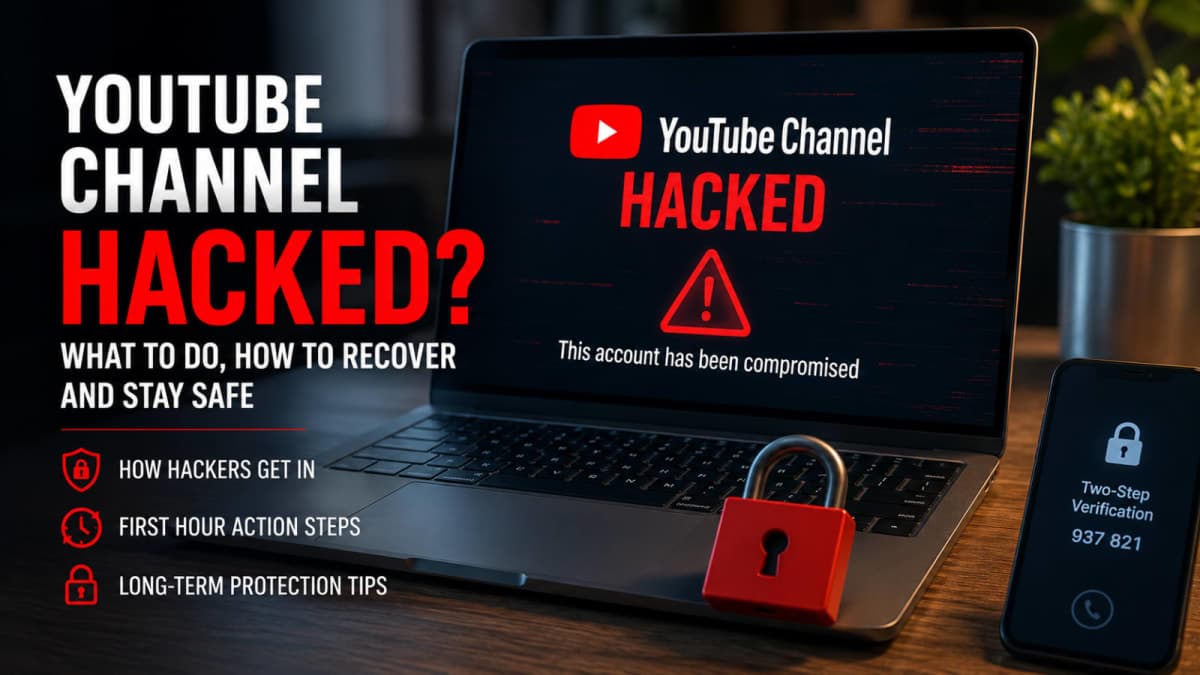
When a popular YouTuber’s YouTube channel hacked incident hits the news, the pattern is almost always the same: crypto scammers steal a live login session, lock the owner out, rename the channel and start a 24-hour fake livestream. The same attacks have hit multiple Indian creators. You can stop most of them with a few concrete habits and know exactly what to do in the first hour if it still happens.
This is not theoretical. Channels with hundreds of thousands or millions of subscribers have been taken over, emptied of videos, and used to push Bitcoin or Tesla-themed scams. The damage is real: lost AdSense earnings, deleted years of work, and days or weeks spent fighting to get the account back. Here is what actually happens and the steps that matter.
What usually happens when a channel is taken over
The attacker almost never “breaks” YouTube’s servers. They steal an active session or trick the owner into installing something that hands over cookies. Once inside the Google account that owns the channel, they change the password, remove the real recovery email and phone, and lock the creator out.
Within minutes the channel name changes to something like “Tesla Live” or a random Elon-Musk-style handle. All existing videos are often made private or deleted. A livestream starts promoting fake crypto giveaways or investment schemes. Viewers who trust the channel get scammed. YouTube eventually notices the policy violations and may terminate the channel entirely.
Indian creators have faced this repeatedly. Finance educators, comedy channels, travel vloggers and even official accounts have been hit. In several cases the recovery email was set to someone the creator trusted, yet that person either removed the link or could not help fast enough. The common thread is speed: the longer the hacker stays in, the harder recovery becomes.

How the hackers get in
Most successful attacks use one of three routes:
Phishing emails or messages. Fake brand-deal or sponsorship offers that look genuine. The attachment or link installs malware that steals browser cookies and active sessions.
Malicious files. PDFs or software claimed to be from a real company. Opening them on a computer that is already logged into Google hands the attacker the session.
Stolen credentials from older leaks. Large collections of passwords from past breaches still circulate. If the same password is reused on the Google account, the door is already open.
Two-factor authentication helps, but session hijacking can bypass it if the attacker already has a live cookie. SMS-based 2FA is especially weak in India because SIM-swap fraud remains common. Authenticator apps and hardware keys are far harder to defeat.
First hour: what to do the moment you notice
Act in this exact order. Do not stop to write long messages or post on social media yet.
Recover the Google account. Open a clean browser or incognito window on a device you normally use and go to g.co/recover. Enter the original email. Use the recovery phone, backup codes or secondary email you set earlier. Avoid VPNs and unfamiliar networks; Google scores consistency of device and location.
Sign out everywhere. Once inside, go to myaccount.google.com/device-activity and remove every unknown device and session.
Change the password. Make it long, unique and never used before. Store it in a password manager.
Fix 2-step verification. Remove any methods the hacker added. Prefer an authenticator app over SMS.
File the YouTube form. Use the official “Restore my hacked or compromised channel” path on support.google.com/youtube. If the channel was terminated, the appeal window is short.
Contact the bank and cyber helpline. If AdSense payouts look suspicious, freeze the linked bank account and report on cybercrime.gov.in or call 1930. Keep the AdSense publisher ID ready.
Creators who recover the Google account within the first few hours have a much higher chance of getting the channel and videos restored. Delays of days turn a recoverable incident into a months-long fight.
Secure the Google account first. Everything else on YouTube depends on it. If the inbox and recovery options are still controlled by the attacker, any channel fixes will be temporary.
Long-term habits that actually reduce risk
These steps take under an hour to set up and stop the majority of common attacks.
Use a dedicated recovery email and phone. Do not set the recovery email to a student, friend or family member who may later change their mind or lose access. Keep the recovery phone number under your own control and update it when you change SIMs.
Turn on passkeys or a hardware security key. These are harder to phish than codes. Google supports them on most modern phones and laptops available in India.
Review channel permissions every month. In YouTube Studio go to Settings → Permissions and remove anyone who no longer needs access. Brand accounts with multiple managers are frequent targets.
Never open unsolicited files. Even if the email looks like it comes from a real brand, verify through a separate known contact. Most session-stealing malware arrives this way.
Check for password leaks regularly. Use Google’s Password Checkup or a trusted breach-checking service. Change any password that appears in a known leak, especially the one tied to your Google account.
Separate the channel from daily browsing. Consider a dedicated browser profile or device for YouTube Studio and Google account management. Limit the number of places you stay logged in.
Also watch for early warning signs: unexpected password-reset emails, logins from cities you have never visited, or sudden changes to recovery options. Act on those immediately rather than waiting for the channel to disappear.

Indian-specific recovery and reporting
Google and YouTube recovery tools work the same worldwide, but Indian creators have extra options that help. File a cyber complaint on cybercrime.gov.in within 24 hours. Mention IT Act sections on identity theft and cheating if money or personal data was involved. The 1930 helpline can guide bank freezes for AdSense-related fraud.
Keep records: screenshots of the renamed channel, the exact time you lost access, AdSense payment IDs, and any emails from Google. These help both the YouTube appeal and any police complaint. If the channel was terminated, the official appeal form is the only reliable path; public tweets to support accounts sometimes speed attention but do not replace the form.
For more practical device and account advice, see our other security guides. The same habits that protect a YouTube channel also protect UPI apps, banking logins and personal email.
What the numbers show and why speed matters
Public reports and creator accounts show the same pattern year after year. A channel is compromised, turned into a crypto livestream within hours, and either restored after a fight or left permanently damaged. The creators who recover fastest are the ones who already had strong recovery options and 2-step verification that did not rely only on SMS.
Password reuse and weak recovery setups remain the biggest preventable risks. Large compilations of old leaked credentials still circulate; if your Google password appears in any of them, change it today. Treat every unexpected email or file asking for account access as hostile until proven otherwise.
The bottom line is simple. Most YouTube channel hacks succeed because the attacker gets a live session or reuses an old password. Lock down the Google account with unique credentials, strong 2-step verification, and recovery options only you control. If the worst still happens, the first hour decides how much of your work and earnings you keep. Set the protections now so you never have to test the recovery process under pressure.